What a Booking Number Means and How to Find One

A booking number is the unique identifier a jail or sheriff's department assigns to a single arrest event the moment someone is processed into custody. It stays attached to that one arrest and lets you pull up the charges, the mugshot, the housing unit, and the custody status tied to it. This article covers the criminal-justice meaning only, not airline or hotel reservation codes.
You'll need a booking number to:
- Track an arrest through a sheriff's inmate roster or jail portal
- Post bail with a bondsman or the jail's own cashier window
- Send commissary funds or schedule a visit
- Match an arrest to the right court case, especially when the State DOC or a service like Registry Recognizer lists someone with a common name
Key Takeaways
A booking number identifies one specific arrest event, and confirming it before using any other identifier prevents most of the record-matching errors that slow down legal and journalistic research.
| Point | Details |
|---|---|
| One number, one arrest | A booking number covers a single custody event and gets reissued on any new arrest. |
| Start with the county roster | County sheriff and jail sites are usually the fastest, most accurate source for a current booking number. |
| Don't confuse identifiers | SID and DOC numbers persist across arrests; a booking number does not, and mixing them up causes rejected transactions. |
| Expect posting delays | Some rosters take up to 24 hours to reflect a new arrest, so an empty search isn't always a dead end. |
| Use Registry Recognizer for fast lookups | Registry Recognizer's county-level database lists booking numbers, charges, and jail locations in a searchable format. |
Table of Contents
- What Is a Booking Number and How Is It Created?
- Where to Find a Booking Number
- How Journalists and Legal Professionals Actually Use a Booking Number
- Booking Number vs. SID and DOC Numbers
- How to Track Down a Booking Number, Step by Step
- Why a Booking Number Search Sometimes Comes Up Empty
- How Registry Recognizer Documents Booking Records
- Why Names Alone Never Settle a Records Search
- Search County Arrest Records With Registry Recognizer
- Frequently Asked Questions
- Sources
What Is a Booking Number and How Is It Created?
Every booking number traces back to a specific intake process. When someone is arrested, the facility runs a set sequence: a search, fingerprinting, a mugshot, and an inventory of personal property. That sequence produces the paperwork and biometric record the jail needs to hold a person legally, and the booking number is the thread that ties it all together.
According to Cornell Law School's Wex legal dictionary, booking is the administrative step where police record an arrest, including the suspect's name, the alleged offense, and identifying details like photographs and fingerprints. The booking number becomes the reference point for all of it.
- Fingerprints and photograph get filed under the same number
- Charges filed at intake attach directly to it
- Housing assignment and custody status update against that same record
One detail trips people up constantly: the number is event-specific. Get arrested twice in the same county and you'll have two different booking numbers, even though you're the same person. A training manual used by the San Diego Sheriff's Department confirms this directly: a new number gets issued for each stay, and the old one stays tied to the record it was created for.
Where to Find a Booking Number
Start local. County-level tools are almost always faster and more accurate than anything else you'll try.
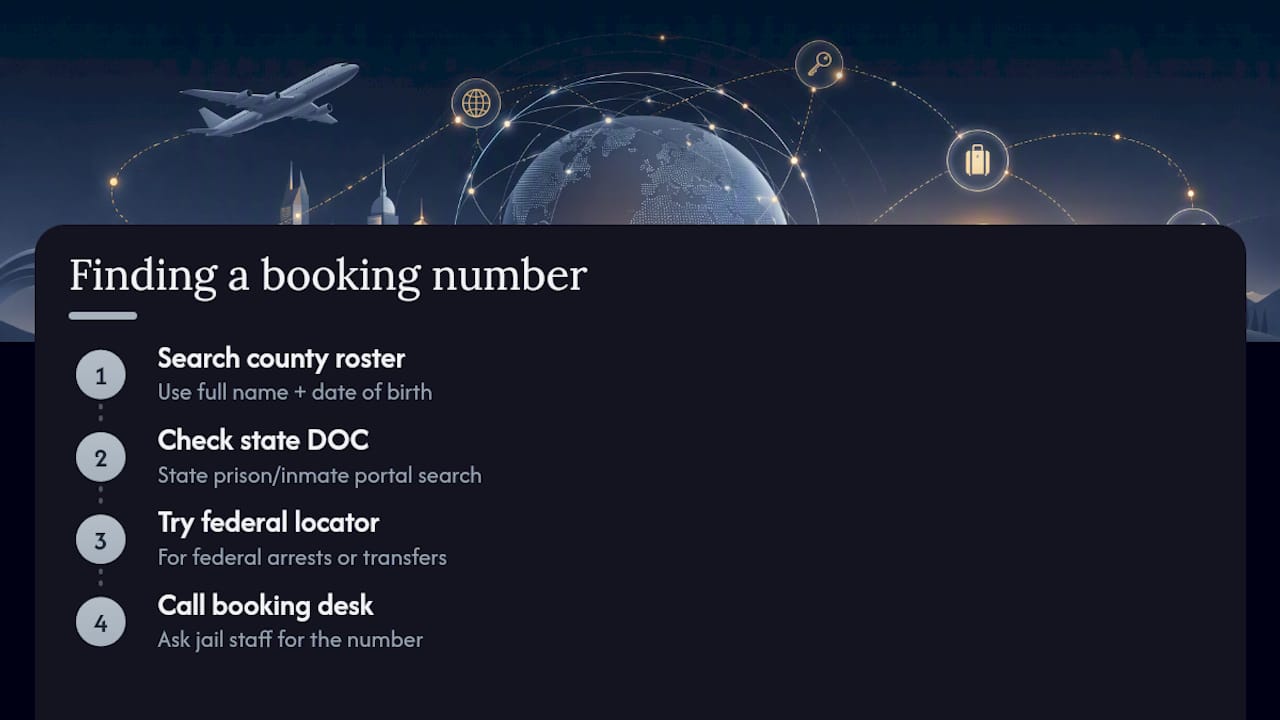
- County sheriff or jail inmate roster. This is the fastest, most reliable source. Most departments let you search by first and last name, and many also ask for a date of birth to narrow results. The San Bernardino County Sheriff's inmate locator is a good example: search by name and the tool returns the booking number alongside charges, bond amount, and housing location.
- State Department of Corrections portals. Once someone is sentenced and transferred out of county custody into state prison, the county roster often drops the record. The state DOC website picks it up under a different, permanent number.
- Federal registries. If the arrest involved federal charges, the county sheriff's site won't have it. You need the federal Bureau of Prisons locator or the U.S. Marshals Service, depending on custody stage.
- VINELink and similar custody-status services. These are useful as a supplement, particularly for victims and family members tracking release dates, but they typically confirm status rather than hand over full booking details.
- Call the booking desk directly. When online search comes up empty, a phone call to the jail's records or booking desk, with the full name and date of birth ready, often resolves it in minutes.
Pro Tip: Call during weekday business hours if you can. Booking desks are often short staffed overnight and on weekends, and requests placed then tend to sit until the next shift change.
How Journalists and Legal Professionals Actually Use a Booking Number
A booking number does real work once you have it. It's the reference clerks and bail agents ask for first, before anything else.
- Posting bail. Give the booking number to a bail agent or the jail's own clerk and they pull up the exact bond amount and conditions tied to that arrest, not a different case with the same name.
- Commissary and visitation. Facilities require the booking number to deposit funds into an inmate's account or to register as an approved visitor. Without it, staff has no fast way to confirm which record you mean.
- Court document matching. Attorneys and court clerks use the booking number to line up an arrest with the correct docket entry, especially when a defendant has prior cases on file.
- Avoiding false matches. Common names generate multiple hits on any roster. A booking number, paired with a date of birth, narrows that list down to exactly one person and one event, which is precisely the identification problem the Catalyst Legal guide on finding an inmate booking number flags as the main reason to prioritize official sources over secondhand aggregators.
Booking Number vs. SID and DOC Numbers
These three identifiers get confused constantly, and mixing them up causes real problems, not just paperwork annoyance.
- Booking number: covers a single arrest event. It expires in practical terms once that case resolves, and a new arrest gets a new one.
- SID (State Identification) number: follows a person across every arrest in that state, tied to their fingerprints rather than any one incident.
- DOC or register number: assigned once someone is sentenced to state or federal custody, and it stays with them through that incarceration and often across future ones.
Using the wrong identifier on a form causes rejected commissary deposits, denied visitation requests, and mismatched court paperwork. The OASIS LegalXML data model used across court filing systems defines bookingNumber specifically as the value issued at entry and held until release, distinct from any permanent tracking ID. If a form or agency asks for a SID or DOC number and you only have a booking number, call the records office and ask them to cross-reference it. They can usually pull the permanent ID in a few minutes.
How to Track Down a Booking Number, Step by Step
Work through these steps in order rather than jumping straight to a phone call.
- Gather the basics first. Full legal name, date of birth, and the county or city where the arrest likely happened. An approximate arrest date helps narrow results fast.
- Search the county jail roster. Try name variations, nicknames, hyphenated last names, middle names used as first names. Rosters are unforgiving about exact spelling.
- Widen the search if the county comes up empty. Check the state DOC site next, then a federal locator if the charges suggest federal jurisdiction. Arrests sometimes get reported under a neighboring county if the incident happened near a border.
- Call the booking desk with specific questions. Ask for the booking number, the booking date, and current housing status. Have the full name and date of birth ready before you dial.
Give it time before assuming the record doesn't exist. Some county systems post arrests within an hour; others take closer to a full day. Utah County's corrections inmate search notes this lag directly on its own search page, and it's typical of jail rosters nationwide.
Pro Tip: Keep a simple log of every search attempt with the date and time. If a record surfaces later, that timestamp helps you figure out how long the actual reporting delay was, which matters if you're writing on deadline or building a case timeline.
Why a Booking Number Search Sometimes Comes Up Empty
Missing records aren't always a mistake. A handful of legitimate reasons explain most gaps.
- Processing lag. Records commonly post anywhere from a couple of hours to a full day after arrest, depending on the county's system.
- Sealed or expunged records. Once a court seals or expunges a case, the booking number tied to it disappears from public rosters entirely, by design.
- Juvenile arrests. Most jurisdictions keep juvenile booking records confidential as a matter of policy, not oversight.
- Active investigations. Some departments withhold booking details temporarily when release could interfere with an ongoing case.
When an online roster shows nothing, that absence isn't proof nothing happened. It often means the record is delayed, sealed, or simply not the kind of case a public-facing system displays.
If you hit a wall, go to the source rather than a workaround. Call the jail directly, check with the court clerk's office, or file a public records request. Be cautious with paywalled or anonymous mugshot aggregators that claim to have "the real record." They frequently scrape outdated data and have no obligation to update or remove it once a case is sealed.
How Registry Recognizer Documents Booking Records
Registry Recognizer maintains a searchable database of county-level arrest records, and each entry is built around the same fields a booking desk generates at intake: charges, jail location, booking date, and custody status.
- The record for Joseph A. Richardson, booked on two charges, shows how a straightforward two-charge case gets presented with full booking detail.
- The record for Jeremiah Jones, booked on seven charges, demonstrates how the same format holds up for a far more complex multi-charge booking.
Both examples reflect the kind of record depth researchers and journalists need when a single booking number has to account for multiple charges, custody changes, or an eventual court date.
Why Names Alone Never Settle a Records Search
Anyone who has spent real time on inmate rosters knows the temptation: search a name, see a hit, assume it's the right person. It usually isn't, at least not with any certainty. Common surnames generate a dozen matches in a mid-size county on any given week, and two men with the same name and birth year is not the rarity people assume.
The booking number is the only piece of that puzzle that isn't shared. That's the part conventional advice tends to undersell. Most guides focus on "how to search a roster" and treat the booking number as an afterthought you'll stumble onto. It should be the first thing you confirm, not the last, because every downstream use, bail, court matching, records requests, depends on having the right one.
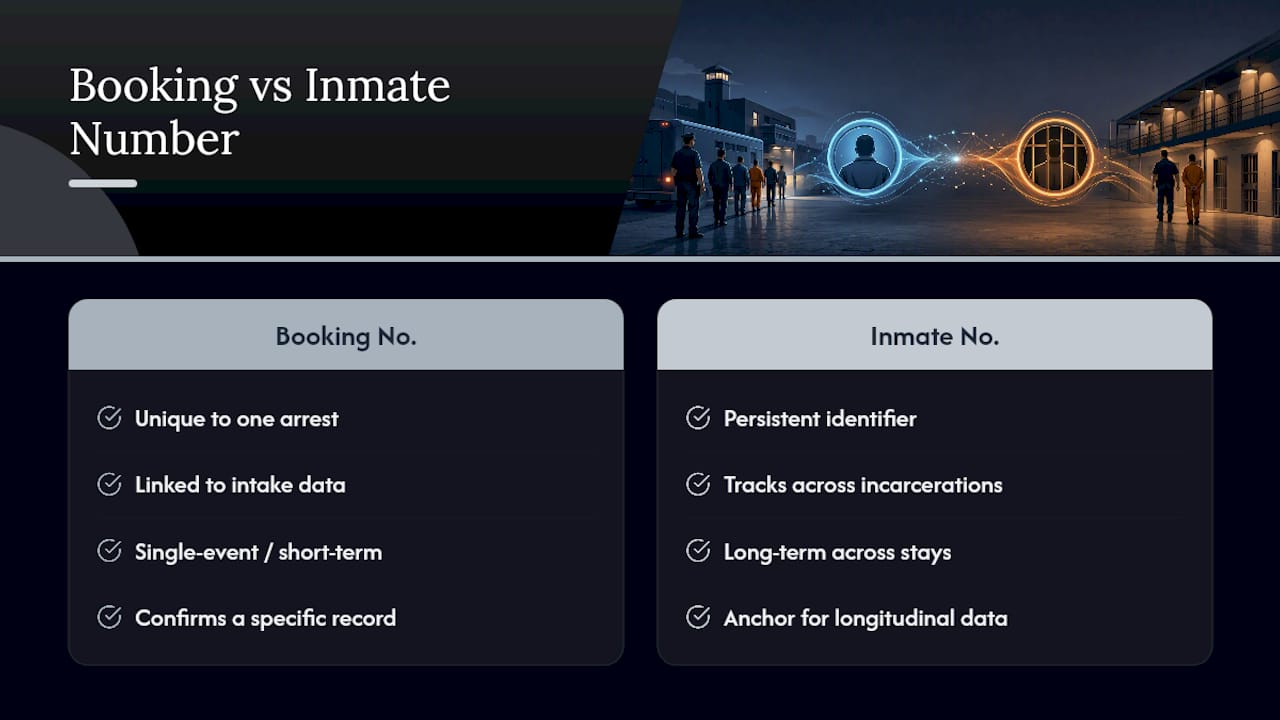
If there's one habit worth adopting from this, it's Registry Recognizer's own approach: treat the booking number as the anchor for a record, not a footnote to it. Journalists on deadline and researchers building longitudinal data sets both lose time chasing names when a booking number, once confirmed, would have settled the question in one search.
Search County Arrest Records With Registry Recognizer
Chasing down a booking number county by county eats time you probably don't have, especially on a deadline or mid case prep. Registry Recognizer solves that by keeping a regularly updated, searchable database of county-level arrest records in one place, complete with booking numbers, charges, jail locations, and disposition status.
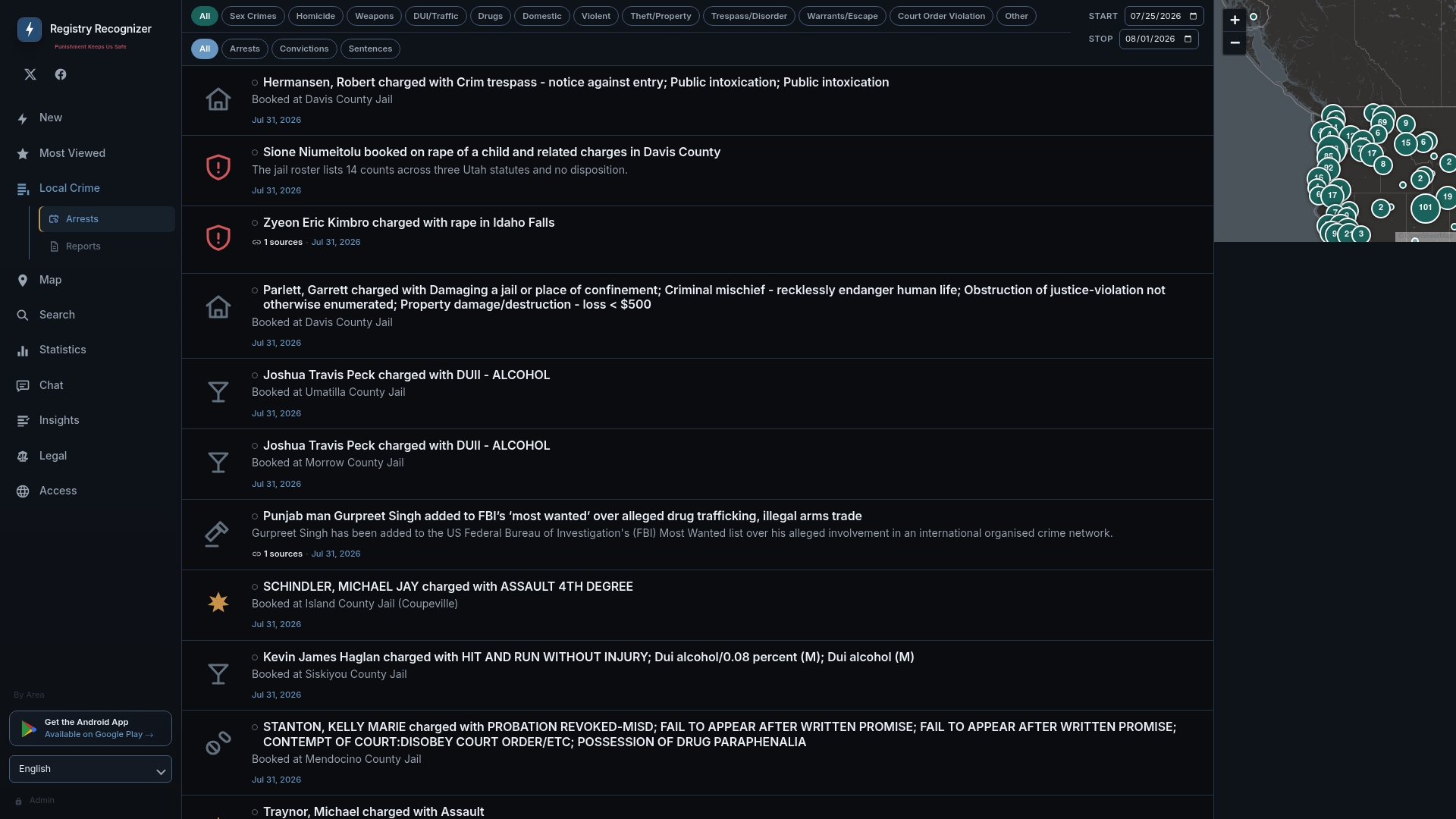
You can filter by county or charge type instead of guessing which jail portal to try next, and each record carries the same detail level shown in listings like Keion Jacquese King's booking record. For journalists, attorneys, and researchers who need to confirm a booking number without spending an afternoon on hold with a records office, that's a direct path to the answer. Start a search on the Registry Recognizer database to see what's on file for your county.
Frequently Asked Questions
What is a booking number in a jail record? It's the unique identifier assigned during intake that links an arrest's mugshot, fingerprints, charges, and custody status to that single event.
How do I find a booking number for someone in jail? Search the county sheriff's inmate roster with the person's full name and date of birth. If that comes up empty, try the state DOC portal, a federal locator, or call the jail's booking desk directly.
Is a booking number the same as an inmate number? No. A booking number covers one arrest, while an inmate or DOC number tracks someone across their entire incarceration and often across future arrests too.
Why can't I find a booking number online? The record may not have posted yet (some rosters take up to a day), or it could be sealed, expunged, or restricted because the person is a juvenile or part of an active investigation.
Can I use a booking number to post bail? Yes. Bail agents and jail clerks use it to confirm the exact bond amount and conditions tied to that specific arrest.
Do booking numbers ever change? The number itself doesn't change once issued, but a person gets a new one for every separate arrest, even in the same county.
Sources
- Cornell Law School — Wex: Booking
- San Bernardino County Sheriff — Inmate Locator
- Catalyst Legal — How to find an inmate booking number
- OASIS LegalXML — ECF JSON model (bookingNumber attribute)