Case Disposition Meaning: A Plain-Language Legal Guide

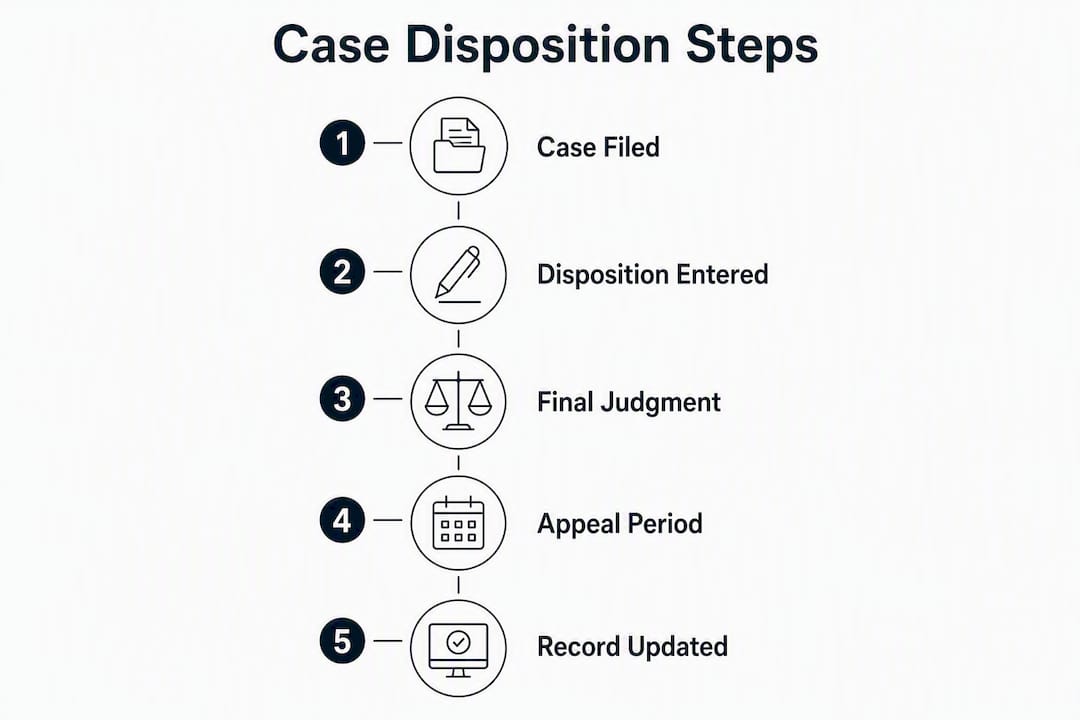
A case disposition is the court's official final outcome for a criminal case, recorded on the docket to show that active proceedings at that court level have ended. According to NJ Courts, a disposition marks the official resolution and signals no further pending actions remain at that level. The most common dispositions you'll see on a criminal record are:
- Convicted (guilty plea or verdict)
- Acquitted (not guilty)
- Dismissed (with or without prejudice)
- Deferred adjudication or diversion (charges held pending program completion)
- Vacated or set aside (prior judgment overturned)
- Pending (not yet resolved)
When a docket simply reads "disposed," that word alone tells you nothing about guilt or innocence. It just means the court is done at that level.
Table of Contents
- What does case disposition mean for your rights and record?
- What are the common types of criminal case dispositions?
- How is disposition different from sentencing?
- How to read a court docket and verify the disposition
- Why disposition timing can determine whether you still have legal options
- Key Takeaways
- The "disposed" label tells you less than you think
- Where to verify official case dispositions
What does case disposition mean for your rights and record?
The word "disposed" is an administrative label, not a verdict. LegalClarity explains that a disposed status shows the case is no longer active but does not reveal who prevailed or what the terms were. To understand the actual legal effect, you need the final judgment or order.
The disposition date is the day the court enters that final resolution. It matters far beyond the paperwork. Once a case is marked disposed, statutory deadlines for appeals and post-conviction motions typically begin running from that date. Miss those windows and you can forfeit rights permanently.
Practical consequences of a recorded disposition include:
- Criminal record entries: A conviction disposition appears on background checks and can affect employment, housing, and licensing.
- Background check visibility: Even a dismissed case may appear on some public records until formally sealed or expunged.
- Expungement or sealing eligibility: Many states require a waiting period measured from the disposition date, not the arrest date.
- Enforceable obligations: Probation terms, fines, and restitution orders attach to the disposition entry and remain enforceable until satisfied.
A disposed case does not vanish. LegalClarity notes that disposition entries create lasting records, and outcomes like vacated, sealed, or expunged judgments require separate formal orders to modify them.
Pro Tip: Never rely on a single-word docket label. Request the final judgment or dismissal order, ideally a certified copy from the clerk's office, to see the precise terms and conditions that govern your rights.
What are the common types of criminal case dispositions?
Each disposition type carries a different legal weight. Here is what each one actually means on a record.

Convicted: The defendant entered a guilty plea or a jury or judge returned a guilty verdict. LegalClarity points out that plea agreements are the most common way criminal cases end. When the court accepts a plea, it enters a conviction for the agreed charges and the case is disposed. On a background check, this shows as a conviction for those specific counts.
Acquitted: A not-guilty verdict from a judge or jury. The defendant cannot be retried for the same offense under double jeopardy protections. An acquittal still appears on some arrest records, though the charge outcome is listed as not guilty.
Dismissed: The court terminates the case without a conviction. The critical distinction here is how it was dismissed:
- With prejudice: The case is permanently closed. The prosecution cannot refile the same charges.
- Without prejudice: Refiling remains possible, subject to the applicable statute of limitations.
LegalClarity confirms that this difference is legally significant and can be outcome-determinative for future prosecutions. Some courts also use administrative dismissals (sometimes called DWOP, or "dismissed for want of prosecution") when a case stalls without action.
Deferred adjudication or diversion: The court holds charges in abeyance while the defendant completes a program, such as drug court or community service. Successful completion typically results in dismissal. Failure sends the case back for prosecution. This outcome often does not count as a conviction but may still appear on records.
Vacated or set aside: A prior judgment is overturned, usually on appeal or through a post-conviction motion. The legal effect varies: some vacated convictions are retried; others are dismissed outright.
A docket showing "disposed" can conceal outcomes as different as a felony conviction and a full dismissal. The label is identical; the legal consequences are not. Always read the underlying order before drawing any conclusion about a person's record.
How is disposition different from sentencing?
These two terms describe separate steps in the same process, and confusing them leads to real misunderstandings about what a court record shows.
Disposition names the final finding or resolution: guilty, not guilty, dismissed. Sentencing is the punishment phase that follows a guilty disposition. CourtCaseFinder emphasizes this distinction: disposition names the finding; sentencing imposes the penalties.
The typical sequence in a criminal case runs like this:
- Arrest and charges filed
- Pretrial proceedings (bail, motions, discovery)
- Plea or trial
- Disposition recorded (guilty, not guilty, dismissed, etc.)
- Sentencing hearing (if the disposition is a conviction)
- Judgment of sentence entered
Common variations on that sequence:
- A plea agreement often includes an agreed sentence, so the court accepts the plea and imposes the sentence in the same hearing. The disposition and sentencing happen on the same day.
- Deferred sentencing after a diversion agreement means the disposition is entered but sentencing is postponed pending program completion.
- An acquittal or dismissal ends the case at step 4. There is no sentencing phase.
CourtCaseFinder also notes that case status labels like "active," "pending," or "closed" describe the stage of proceedings, not the substance of the result. A case can be "closed" administratively without a substantive disposition having been entered.
How to read a court docket and verify the disposition
Online docket labels are often incomplete. Here is how to get the full picture.
- Gather the case number and party name. Every court record is indexed by case number. If you do not have it, search the court's public docket portal by name.
- Search the court's online docket portal. Most state trial courts now offer free public access. Federal cases are on PACER.
- Locate the disposition entry. Look for a docket line labeled "disposition," "judgment," or "final order." Note the disposition date and the judge's name.
- Open the underlying document. The docket line links to the actual order. That document states the precise terms: the charge, the finding, any conditions, and the sentence if applicable.
- Request a certified copy if needed. If the online version is incomplete or you need an official document for legal purposes, contact the county clerk's office directly.
CourtCaseFinder confirms that official sources for verifying dispositions include county clerk offices, court docket portals, state court websites, and PACER for federal cases. Online labels alone can be incomplete.
Pro Tip: If the docket shows only "disposed" or "closed" with no linked document, call or visit the clerk's office and request the final judgment or dismissal order by case number. Clerks are required to provide public records; a certified copy costs a small fee but carries official weight.
Why disposition timing can determine whether you still have legal options
The disposition date is not just a timestamp. It is the starting gun for several legal deadlines, and missing them can permanently close off options.
Once a case is marked disposed, the clock starts on:
- Notice of appeal: In most states, defendants have 30 days from the disposition or sentencing date to file a notice of appeal in a criminal case. Federal rules set a similar window.
- Motion to vacate or withdraw a plea: Many jurisdictions require these motions within a set period after the disposition is entered.
- Post-conviction relief petitions: Habeas corpus and similar petitions carry their own deadlines, often measured from when the conviction became final.
- Expungement eligibility: Waiting periods for sealing or expunging a record typically run from the disposition date.
LegalClarity notes that once a case is marked disposed, strict legal deadlines for appeals or motions usually begin running from that date. State rules vary significantly, so the specific window depends on the jurisdiction and the type of motion.
The moment you learn a case has been disposed, note the date and consult an attorney or the clerk's office to identify which deadlines apply. Waiting even a few days to look into it can matter.
This article is general information, not legal advice. Confirm current deadlines and procedural rules with the issuing court or a licensed attorney in your jurisdiction.
Key Takeaways
A case disposition is the court's official final outcome, and the disposition date starts the clock on appeals, expungement eligibility, and other post-conviction deadlines.
| Point | Details |
|---|---|
| Disposition vs. "disposed" | "Disposed" is an administrative label; the final order reveals the actual outcome and legal terms. |
| Common disposition types | Convicted, acquitted, dismissed (with or without prejudice), deferred/diverted, and vacated each carry different legal consequences. |
| Disposition vs. sentencing | Disposition names the finding; sentencing is the separate punishment phase that follows a guilty disposition. |
| Disposition date deadlines | Appeal windows and post-conviction motions typically run from the disposition date — missing them can forfeit rights. |
| How to verify | Request the final judgment or certified copy from the county clerk; do not rely on a single docket label. |
The "disposed" label tells you less than you think
There is a gap between what most people assume when they see "disposed" on a docket and what that word actually communicates. It is essentially a filing-cabinet label. The court is telling its own system: this case is no longer on the active list. It says nothing about whether someone was convicted, whether charges were dropped, or whether any conditions were attached.
That gap matters most when someone is reviewing a record quickly, whether for a background check, a legal proceeding, or personal research. Seeing "disposed" and moving on is a mistake that practitioners avoid by default. They go straight to the final order.
The same logic applies to anyone reading public arrest records. Registryrecognizer provides searchable arrest and disposition status information across counties, which is useful for an initial search. But a docket label on any public database, including this one, is a starting point. The certified court record is the authoritative document. If the outcome of a case affects a legal decision, a job, or a housing application, the underlying order is the document that actually governs.
Where to verify official case dispositions
These are the authoritative sources for confirming a disposition and obtaining the underlying order.
- County clerk's office: The primary custodian of trial court records. You can request certified copies of judgments, dismissal orders, and docket sheets in person, by mail, or through the court's online portal. Fees vary by county.
- State court docket portals: Most states maintain free public-access portals for trial and appellate court records. Search by case number or party name to find the docket and linked documents.
- PACER (Public Access to Court Electronic Records): The federal judiciary's official docket system. Use it for any case filed in U.S. District Court, Bankruptcy Court, or the Courts of Appeals. Access requires a registered account; fees are modest.
- State appellate court websites: If a case was appealed, the appellate court's website or docket portal will show the appellate disposition separately from the trial court's entry.
- Certified copy requests: When you need an official document for legal, employment, or immigration purposes, request a certified copy directly from the clerk. A certification stamp confirms the document is a true copy of the court's official record.
Registryrecognizer's searchable records database includes booking information, charges, and disposition status drawn from public records across multiple counties. It is a practical starting point for locating a case, but it is not a substitute for certified court records when official documentation is required.
Recommended
- CAPRAI, CASEY GLENN charged with DOC CONTRACT · Registry Recognizer
- Leanne Mayre Greene charged with PC 166(A)(4) - CONTEMPT OF COURT:DISOBEY COURT ORDER/ETC · Registry Recognizer
- WOOD, TOBIAS CODEE charged with CONTEMPT OF COURT:DISOBEY COURT ORDER/ETC · Registry Recognizer
- Alden Collins charged with PROH WEAPON · Registry Recognizer