How to Find Inmate Release Dates Across U.S. Systems

For a federal inmate, start with the BOP inmate locator, which covers records from 1982 to the present and updates daily. For state prisoners, go directly to the relevant state Department of Corrections website. For someone held in a county or city jail, check that county's booking page. To get automatic alerts when custody status changes, register at VINELink.
Here are three immediate steps:
- Check the right official source first. Federal offense? BOP locator. State conviction? State DOC site. Local arrest or pretrial hold? County jail booking page.
- Verify by phone or VINELink. A listed date is an estimate. Call the facility or sign up for VINELink notifications to confirm before acting on any date.
- Escalate if the status shows "Unknown." Contact the facility directly, then the sentencing court, then a parole or probation office if the person may be on supervised release.
Quick-reference sources by jurisdiction type:
- Federal locator: bop.gov/inmateloc
- State DOC: search "[state name] Department of Corrections inmate search"
- County jail booking: search "[county name] jail booking report" or "[county name] sheriff inmate search"
- Release notifications: vinelink.com
Table of Contents
- Who publishes inmate release dates and what each source shows
- How to use the Federal Bureau of Prisons inmate locator
- How to look up state DOC and county jail release dates
- How release notification systems like VINELink work
- Why release dates are labeled "projected" and why they change
- What to do when a release date is missing or shows as "Unknown"
- When release information is sealed or unavailable
- How often official databases update and what that means for accuracy
- How Registryrecognizer complements official locators
- Key Takeaways
- Why the date on the screen is never the whole story
- Registryrecognizer makes local booking searches faster
- Authoritative sources and when to use each
Who publishes inmate release dates and what each source shows
Release-date information in the U.S. is not held in one place. It is spread across at least four distinct systems, each covering a different slice of the incarcerated population.
| Source | Who it covers | Typical data published |
|---|---|---|
| Federal Bureau of Prisons (BOP) | Federal inmates sentenced to BOP custody | Register number, projected release date, facility, custody status |
| State Department of Corrections | State-sentenced prisoners (felonies, longer sentences) | Projected/earliest release date, parole eligibility, facility, offense |
| County/city jail booking systems | Pretrial detainees, misdemeanor sentences, short-term holds | Booking date, charges, release date, booking agency |
| Courts and parole/probation boards | Supervised release, probation, parole conditions | Parole eligibility date, hearing dates, supervision status |
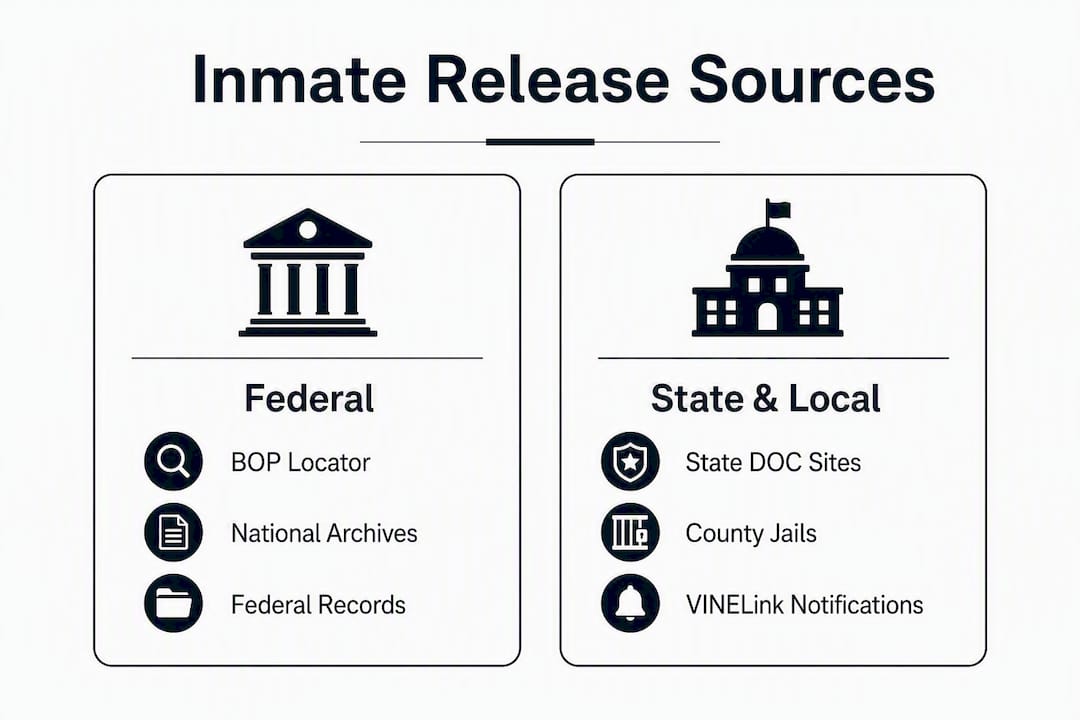
The practical rule: if the offense was federal, the BOP is the first call. If the person was convicted in state court and sentenced to more than a year, the state DOC is the right place. If the arrest was recent and the person has not yet been sentenced, or if the charge is a misdemeanor, a county booking page will usually have the most current information.
One important caveat about older federal records: the BOP recommends contacting the National Archives and Records Administration (NARA) for records predating 1982, because those older files were not keyed into the current BOP system. If you are researching a case from the 1970s or earlier, NARA is the right starting point, not bop.gov.
Pro Tip: If you are unsure whether a person was convicted federally or at the state level, check the BOP locator first. A result there confirms federal custody. No result does not mean they are free — it means you need to check the state DOC next.
How to use the Federal Bureau of Prisons inmate locator
The BOP inmate locator is the authoritative source for federal release dates, and it is free to use. Here is how to get the most out of it:
- Go to bop.gov/inmateloc — You can search by the inmate's first and last name or by their BOP Register Number. The Register Number search is faster and more precise if you have it.
What "UNKNOWN" in the release date field actually means
The BOP is specific about this: "UNKNOWN" in the Release Date field typically indicates one of three situations. The person is pretrial and has not yet been sentenced. A confinement term has not been formally set. Or the person is under civil commitment rather than a standard criminal sentence. In none of these cases does "UNKNOWN" mean the record is wrong or the person is not in custody.
If the BOP listing is confusing or shows a status you cannot interpret, call the facility directly. Ask for the case manager's unit or the records office. Have the Register Number ready, and say: "I am trying to confirm the projected release date for [full name], Register Number [number]. Can you tell me the current release date on file and whether there are any pending recalculations?" That phrasing gets you past the front desk faster than a general inquiry.
How to look up state DOC and county jail release dates
State DOC sites and county booking systems work very differently, and knowing which one to use saves real time.

State DOC sites cover people who have been sentenced to state prison, typically for felonies carrying sentences longer than one year. Most states publish a searchable inmate locator. The Texas Department of Criminal Justice, for example, lists location, offenses, and projected release date in its online search. Virginia's DOC provides a locator covering both people in custody and those under community supervision. North Carolina's Department of Adult Correction maintains records going back to 1972.
The language varies by state. New York labels its dates "earliest release date" or "conditional release date." South Carolina's release-date calculator assumes the inmate earns maximum possible good-time and work credits, which means the projected date it shows can be earlier than the actual release if those credits are not fully earned. When you see a state DOC date, treat it as an optimistic estimate unless the state explicitly says otherwise.
County and city jail booking pages are the right tool for pretrial detainees and people serving short sentences locally. Many counties publish daily booking reports. Whatcom County, Washington, for instance, publishes a searchable table of bookings by date, showing both booking date and release date. Larimer County, Colorado does the same with a daily booking report that includes booking agency details. Some county sites, though, only show current population without historical release data.
Pro Tip: When calling a county jail to ask about a release date, have three pieces of information ready before you dial: the person's full legal name, date of birth, and booking number if you have it. Jails field dozens of these calls daily; giving the booking number immediately cuts the hold time.
For Los Angeles County specifically, a dedicated LA County inmate search tool can help you locate someone held locally and check current custody status before calling the facility.
How release notification systems like VINELink work
VINELink (Victim Information and Notification Everyday) is the most widely used notification system in the U.S. for tracking custody status changes. It was built primarily for crime victims but is available to anyone who wants alerts about a specific person's custody status.
Here is how to register:
- Search for the offender — by name or offender ID within the jurisdiction you select.
- Note the coverage — VINELink coverage varies by state and county. Not every facility participates, and some rural counties may not be connected to the system at all. If your jurisdiction is not listed, contact the local sheriff's office or facility directly to ask about their notification options.
One limitation worth knowing: VINELink notifications depend on the local facility updating its own system. If a county jail runs on older software or updates its records manually, there can be a lag between an actual release and the alert you receive. For high-stakes situations, a direct phone call to the facility the day before an expected release is still the most reliable confirmation.

Why release dates are labeled "projected" and why they change
The word "projected" is not bureaucratic hedging. It reflects a genuine legal reality: a release date is a calculation, not a fixed event, and several factors can move it in either direction.
The starting point is the sentence imposed by the court. From there, corrections agencies apply statutory formulas that account for good conduct time, program participation credits, and time already served. The result is a projected date. But that date can shift after it is first published.
A projected release date is a calculated estimate based on current sentence length, earned credits, and applicable statutes. It is not a legal guarantee of release on that date. Disciplinary sanctions, parole board decisions, sentence recalculations under legislation like the First Step Act, civil commitment proceedings, or a transfer to another jurisdiction can all move the date forward or backward. Verify any projected date close to the expected release, not months in advance.
Common scenarios that push a date later: a disciplinary infraction that results in loss of good-time credits, a parole board denial, or a civil commitment order filed before the sentence ends. Common scenarios that pull a date earlier: earned time credits applied under the First Step Act, successful program completion, or a sentence modification granted by the court.
The First Step Act introduced a specific complication for federal cases. Because time-credit recalculations under the Act are ongoing and can be applied retroactively, a release date that was accurate last month may have shifted. The BOP itself notes that displayed dates may not always reflect the most current calculation. Checking periodically, rather than once and assuming the date is final, is the prudent approach for anyone tracking a federal case closely.
State DOC committees add another layer. In New York, for example, a Time Allowance Committee reviews an inmate's program participation and behavior and can adjust the conditional release date shortly before the projected release. That decision happens internally and may not appear in the public-facing locator immediately.
What to do when a release date is missing or shows as "Unknown"
A missing or "Unknown" release date is not a dead end. Work through these sources in order:
- BOP or state DOC locator first — Confirm the person is in that system. If they appear but the date is blank or "Unknown," the most likely explanations are pretrial status, an unset sentence, or a pending recalculation.
If you reach a facility and the staff cannot confirm a release date, ask specifically: "Can you tell me whether [full name], DOB [date], is currently in your custody, and if so, whether a projected release date has been set?" That phrasing avoids the common response of "we can't give out that information" because you are asking for a yes/no on custody status first, then the date.
When information is legally restricted — a sealed record, a protective order, or a sensitive program placement — you will need either a court order or legal counsel to access it. A public records attorney or the sentencing court's clerk can tell you what process applies.
When release information is sealed or unavailable
Not all custody records are public, and knowing the common restrictions saves wasted effort.
- Juvenile records are sealed in most states. A person arrested or sentenced as a minor will not appear in standard public locators.
- Sealed or expunged records are removed from public databases after a court order. The person may have served time, but the record will not show in a public search.
- Protective orders and sensitive program placements can restrict location information. If an inmate is in a witness protection program or a sensitive housing unit, their facility location may not be publicly listed.
- Pending immigration holds can complicate release dates. An inmate who completes a criminal sentence may be transferred to ICE custody rather than released, and that transfer will not always appear in the state DOC locator.
- Records under appeal or pending resentencing may show outdated or incomplete release information while legal proceedings are active.
Pro Tip: A record appearing in a public database does not confirm the person is currently in custody. It confirms they were booked at some point. Always check the custody status field, not just the existence of a record.
If records are sealed and you have a legitimate legal need for access, the process typically involves filing a motion with the court that issued the sealing order. A public defender's office or a private attorney can advise on whether your situation meets the threshold for access.
How often official databases update and what that means for accuracy
The BOP updates its inmate locator daily. That is the most current of any major U.S. corrections database. State DOC update schedules vary widely. Some states refresh their public-facing locators nightly; others update weekly or on a less predictable schedule. County jail booking pages range from near-real-time (some update within hours of a booking) to daily batch updates.
A few practical rules for assessing data freshness:
- Look for a timestamp or "last updated" field on the results page. Many state DOC sites display the date the record was last modified. If that date is more than a week old, call the facility to confirm.
- For high-stakes situations, verify by phone the week before the projected date. A date that was accurate three months ago may have shifted due to a disciplinary action, a First Step Act recalculation, or a parole board decision.
- County booking pages are often the freshest for local holds. Because they track daily bookings and releases, they tend to reflect same-day or next-day changes for pretrial detainees.
- VINELink is event-driven, not time-driven. It sends an alert when a status change is recorded in the local system, which means its accuracy depends entirely on how quickly the local facility updates its own records.
The gap between a real-world event (a release, a transfer, a recalculation) and its appearance in a public database is the single biggest source of confusion when checking release information. No public database is a live feed. Treat every listed date as a starting point, not a final answer.
How Registryrecognizer complements official locators
Official government locators are the authoritative source for projected release dates and custody status. Registryrecognizer serves a different but complementary purpose: it aggregates county-level booking records, arrest information, mugshots, charges, and jail locations across multiple jurisdictions into a single searchable database.
Here is where that distinction matters in practice:
- Recent local bookings. If someone was arrested in the last 24–72 hours, a state DOC site will not show them yet. Registryrecognizer's county-level data can surface a booking record faster than waiting for a state system to update.
- Aggregated county data. Searching across multiple counties one at a time is slow. Registryrecognizer consolidates records so you can search by name across jurisdictions without visiting each county site individually.
- Charge and offense details. Official locators often show a projected release date without much context about the underlying charges. Registryrecognizer includes charge categories, offense descriptions, and booking photos, which helps confirm you have the right person before making a phone call.
- Parole and supervision violations. Entries like parole violation records and post-release supervision charges can appear in Registryrecognizer before they are reflected in an updated state DOC profile.
Registryrecognizer is a supplementary research tool, not a replacement for official government sources. For any decision that depends on a confirmed release date — a safety plan, a legal filing, a travel arrangement — verify the date directly with the BOP, state DOC, or facility before acting on it.
The practical workflow: use Registryrecognizer to locate a booking quickly and confirm basic details, then go to the official locator to verify projected release date and custody status. The two sources answer different questions.
Key Takeaways
The most reliable way to find an inmate's release date is to match the jurisdiction to the correct official source, then verify by phone or VINELink before acting on any projected date.
| Point | Details |
|---|---|
| Match source to jurisdiction | Use BOP for federal inmates, state DOC for state prisoners, county booking pages for local and pretrial holds. |
| "Projected" means estimated | Dates can shift due to disciplinary actions, First Step Act recalculations, or parole board decisions — verify close to the expected date. |
| "Unknown" has specific causes | BOP's "Unknown" release date signals pretrial status, an unset sentence, or civil commitment — not a missing record. |
| Register for VINELink | Sign up at vinelink.com for automatic custody-status alerts; confirm coverage for your specific county before relying on it. |
| Registryrecognizer for local booking visibility | Use Registryrecognizer to search aggregated county arrest and booking records quickly, then confirm release dates with the official government source. |
Why the date on the screen is never the whole story
The conventional wisdom is that finding a release date is a lookup problem. Go to the right website, enter a name, and you have your answer. That framing misses the most important part.
Every projected date in every corrections database is a snapshot of a calculation made at a specific moment, under a specific set of assumptions about behavior, credits, and legal status. The moment any of those assumptions changes, the date changes too. A disciplinary infraction filed the week before a projected release can push the date back by months. A First Step Act credit applied retroactively can pull it forward by weeks. Neither event will necessarily appear in the public-facing locator the same day it happens.
The readers who get into trouble are the ones who check a date once, months in advance, and treat it as settled. The readers who get it right check once to get oriented, then verify again the week before, and call the facility if anything is at stake. That second call is not redundant. It is the actual answer.
There is also an ethical dimension worth naming. Public records are public for legitimate reasons: transparency, safety, accountability. Using them to confirm a release date for a family member, a legal matter, or a safety concern is exactly what they are designed for. Using them to harass, surveil, or intimidate someone who has served their sentence is not. The information being accessible does not make every use of it appropriate.
Registryrecognizer makes local booking searches faster
When you need county-level booking data quickly, searching individual county sheriff sites one at a time is slow and inconsistent. Registryrecognizer aggregates arrest records, booking details, mugshots, charge categories, and jail locations across multiple counties into a single searchable database, updated regularly.
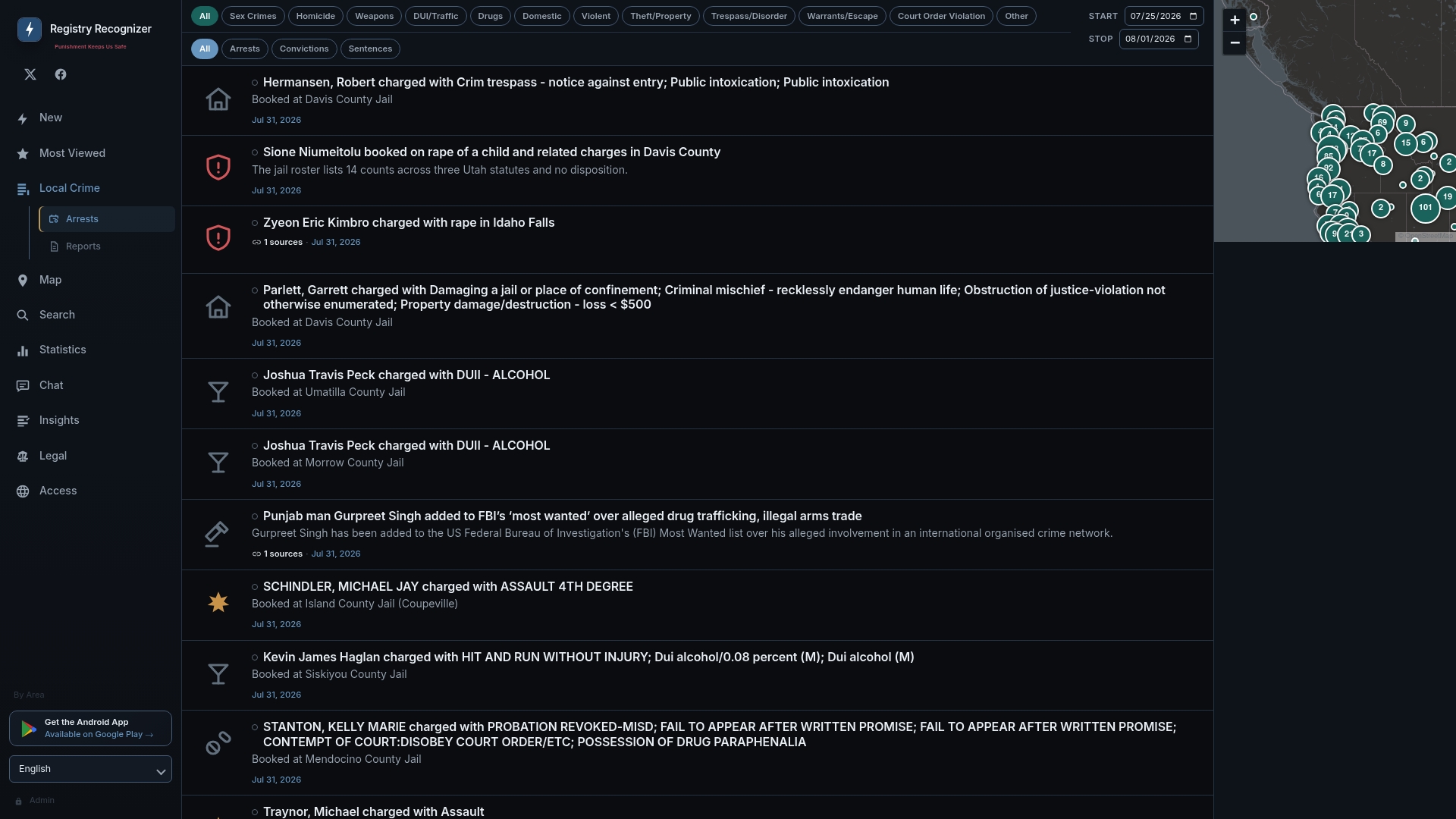
The database is useful in specific situations: a journalist tracking the booking history of a local case, a family member who needs to confirm where someone was booked before the state DOC record updates, or a legal professional verifying arrest details and charge descriptions across jurisdictions. Registryrecognizer also covers probation violation bookings and post-release supervision charges that can surface before official DOC profiles reflect the new custody status.
For confirmed projected release dates, the BOP, your state DOC, and the facility itself remain the authoritative sources. Registryrecognizer is the faster first step for local booking visibility. Search the database at Registryrecognizer to find county arrest and booking records now.
This article provides general informational guidance only. Confirm current custody status and release dates directly with the relevant government agency or a qualified legal professional before making any decision based on that information.
Authoritative sources and when to use each
| Source | Best used when | Notes |
|---|---|---|
| BOP Inmate Locator | Confirming federal custody and projected release date | Updated daily; covers 1982–present |
| State DOC locator (e.g., Virginia DOC, Texas TDCJ, NC DAC) | State-sentenced prisoners; parole and supervision status | Update schedules vary by state; check for a "last updated" timestamp |
| County jail booking pages (e.g., Whatcom County, Larimer County) | Pretrial detainees; recent local arrests; short-term holds | Often updated daily or faster; some counties show only current population |
| VINELink (vinelink.com) | Receiving automatic alerts on custody status changes | Coverage varies; not all counties participate |
| NARA (archives.gov) | Federal records predating 1982 | BOP locator does not include pre-1982 records |
To verify a date by phone, call the facility's records office or case manager unit. Have the person's full legal name, date of birth, and any ID number (BOP Register Number, state DOC number, or booking number) ready before you call. Ask specifically for the "projected release date currently on file" rather than a general inquiry about the case. Check whether the site you used shows a "last updated" or "record modified" timestamp, and if the date shown is more than a week old on a state or county system, treat the phone call as the authoritative answer.
Recommended
- Registry
- Dangelo Sanchez charged with PC 3455(A) - VIOLATION OF POST RELEASE SUPERVISION · Registry Recognizer
- RANDALL, DONALD LAMAR charged with VIOLATION OF PAROLE · Registry Recognizer
- ANTHONY QUINTON ORAN SMITH charged with FAIL TO ID FUGITIVE INTENT GIVE FALSE INFO PC 38.02(D)(2) · Registry Recognizer