Release on Recognizance: What Defendants and Families Should Know

Release on recognizance means a judge lets a defendant leave jail before trial without paying bail, based solely on a signed promise to show up for every court date. Courts also call this OR, ROR, own recognizance, or a PR bond (personal recognizance bond), and in most jurisdictions no upfront payment is required, though some counties tack on a small administrative fee regardless of the outcome.
The terminology gets thrown around loosely, so here's the shorthand you'll actually hear in a courtroom or read on a booking sheet:
- OR / O.R. — own recognizance
- ROR / R.O.R. — released on own recognizance
- PR bond — personal recognizance bond, same concept, different label used mostly in Texas and a handful of other states
- Signature bond — another regional synonym, common in parts of the Midwest
Key Takeaways
Release on recognizance lets a defendant leave custody before trial on a signed promise to appear, with no bail money required in most cases, though eligibility depends entirely on judicial discretion.
| Point | Details |
|---|---|
| No money required | OR relies on a written promise to appear, though some counties add small administrative fees. |
| Timing is fast | Initial hearings deciding OR typically happen within 24 to 48 hours of arrest. |
| Judges weigh several factors | Charge severity, criminal history, community ties, and flight risk all shape the decision. |
| Conditions still apply | Check-ins, travel limits, and no-contact orders often come attached to an OR release. |
| Violations escalate quickly | Missing court or breaking conditions can trigger a bench warrant and a separate failure-to-appear charge. |
Table of Contents
- What Does Release on Recognizance Mean for the Court Process?
- What Factors Determine Eligibility for Own Recognizance Release?
- What Conditions Come With an OR Release?
- How Do You Request an OR Release?
- What Happens If You Violate an OR Release?
- How Does OR Differ From Cash Bail and Surety Bonds?
- How Do State and Federal Statutes Handle Recognizance Release?
- Where Can You Verify Bond and Release Status?
- What Should Defendants and Families Actually Do Before an OR Hearing?
- Where to Learn More About Release on Recognizance
- Frequently Asked Questions About Release on Recognizance
- Sources
What Does Release on Recognizance Mean for the Court Process?
Once someone is arrested, the clock starts on a fairly rigid schedule. In most U.S. jurisdictions, the initial appearance or bail hearing happens within 24 to 48 hours of arrest, weekends and holidays sometimes stretching that window slightly. This is the hearing where OR gets decided, one way or another.
Here's how that hearing typically unfolds:
- The defendant appears before a judge or magistrate, usually by video link from the jail in larger counties.
- The court reviews a pretrial services report, if the jurisdiction has a pretrial services agency. That report usually covers criminal history, employment status, residence stability, and sometimes a risk-assessment score.
- The prosecutor and defense attorney each get a chance to argue for or against OR, citing the report and the facts of the case.
- The judge rules, either granting OR, setting a cash or surety bond, or in serious cases denying release entirely.
- If OR is granted, the defendant signs a written promise to appear and receives a paper listing every condition attached to release, plus the next court date.
That signature is the whole transaction. No bondsman, no collateral, no fee changing hands at the counter, though the paperwork itself is legally binding, and skipping a court date after signing it carries real consequences.
Pro Tip: Ask your attorney, before the hearing, whether your county's pretrial services agency conducts phone or in-person interviews. Being reachable and cooperative during that interview often matters more to the outcome than anything said in the courtroom.
What Factors Determine Eligibility for Own Recognizance Release?
Judges have wide latitude here, and the own recognizance standard set out by Cornell's Legal Information Institute) makes clear that even a defendant who looks low-risk on paper isn't guaranteed OR. It's a judgment call, not a checklist with a pass/fail score.
The factors that carry the most weight tend to be:
- Severity of the current charge (violent felonies almost never get OR)
- Criminal history, especially prior failures to appear
- Community ties: steady employment, local family, a fixed address
- Perceived flight risk
- Any indication the defendant poses an ongoing threat to public safety
First-time offenders, traffic cases, and minor misdemeanors are where OR gets granted most routinely. A Legal Reader analysis of judicial decision-making notes that defendants with strong roots in the community and no history of violence are considered far more often than those without, though the article stresses the decision always stays discretionary rather than automatic.
Own recognizance release is not a right. The federal pretrial release framework instructs courts to start with the least restrictive alternative available, which in practice means OR gets considered first for defendants who don't present a clear risk, before the judge escalates to conditions, bond, or detention.
What Conditions Come With an OR Release?
Signing a promise to appear rarely means walking out with zero strings attached. Most OR releases carry a handful of standard conditions, and judges can add more depending on the charge.
Common conditions include:
- Attending every scheduled court date without exception
- Staying within a defined geographic area or surrendering a passport in rare cases
- Complying with no-contact or protective orders where domestic violence or harassment charges are involved
- Submitting to drug testing or enrolling in treatment if substance use is tied to the arrest
- Checking in periodically with a pretrial services officer, by phone or in person
Conditions vary widely by county and by the nature of the charge, and violating even one of them, not just missing court, can trigger a revocation hearing.
Pro Tip: Keep a simple log of every check-in, drug test, or court appearance, with dates and the name of whoever you spoke with. If a dispute comes up later about compliance, that record is worth more than your memory.
How Do You Request an OR Release?
In felony cases, a defense attorney typically files the request with the judge assigned to the case, though in many misdemeanor courts a magistrate will consider OR automatically for qualifying non-violent charges without anyone having to ask. Either way, preparation matters more than most people expect.
- Gather background information before the hearing, including proof of employment, a lease or mortgage statement, and any documentation of family ties in the area.
- Line up community witnesses — an employer, a landlord, a family member willing to speak or submit a letter confirming stability.
- Prepare a short, specific statement, not a speech. Judges respond better to concrete facts (job start date, years at the same address) than general pleas.
- File a motion to modify bond if OR is initially denied, once circumstances change, such as securing stable housing or resolving an unrelated warrant.
If the judge denies OR at the first hearing, that's not necessarily final. Attorneys routinely revisit the issue weeks later once they can point to something concrete that's changed.
Pro Tip: If OR is denied, ask your attorney immediately what specific factor drove the denial. Knowing whether it was the charge, a prior FTA, or an unstable address tells you exactly what to fix before the next motion.
What Happens If You Violate an OR Release?
Breaking the terms of an OR release carries consequences that escalate fast, and courts don't treat a missed check-in the same as a minor scheduling mistake.
- Immediate revocation of the release and issuance of a bench warrant
- Re-arrest, often followed by detention for the remainder of the case with no further OR eligibility
- A separate failure-to-appear charge, which carries its own penalties independent of the original case
- A harder bond the second time around, since judges rarely extend OR twice to the same defendant
Penalties for failure to appear vary significantly by state and by whether the underlying case was a misdemeanor or felony, with felony-related failures to appear generally carrying steeper consequences than misdemeanor ones. A missed hearing doesn't just cost you your freedom pending trial. It also damages your credibility with the same judge who'll be deciding your case going forward.
How Does OR Differ From Cash Bail and Surety Bonds?
The core distinction is money. OR asks for a signature; every other release type asks for cash, property, or a bondsman's guarantee, and that difference shapes everything else about how each option works.

| Release Type | Payment Required | Who Bears the Risk | What Happens on FTA |
|---|---|---|---|
| Own recognizance | None (administrative fees possible) | Defendant's legal standing only | Bench warrant, new charge, no financial loss |
| Cash bail | Full bond amount, refundable if case resolves properly | Defendant or family who posted cash | Forfeiture of the full amount |
| Surety bond | Percentage fee to a bondsman (typically nonrefundable) | Bondsman, backed by collateral from defendant/family | Bondsman may seize collateral, hire bounty hunter |
| Unsecured bond | None upfront, but a set amount is owed on FTA | Defendant, financially, if they miss court | Court can seize the full unsecured amount |
Judges lean toward OR when the flight risk looks low and the charge is non-violent. They lean toward cash or surety when the criminal history is heavier or the charge involves violence, because state resources on bond types generally frame the choice as a balance between public safety and the burden of pretrial detention on someone not yet convicted.
For families weighing the practical difference between paying a bondsman and waiting on an OR decision, a bail-versus-bond comparison from the bail industry lays out the cost tradeoffs in more detail than most court self-help pages bother to.
The upside of OR is obvious: no money changes hands, and the defendant isn't beholden to a bondsman. The downside is just as real. Courts can revoke it faster than they'd move to seize collateral, since there's no financial transaction to unwind first.
How Do State and Federal Statutes Handle Recognizance Release?
Every state writes its own rules for OR, and the differences matter more than most people assume when they're sitting in a courtroom waiting to find out what happens next.
- Federal cases follow the Bail Reform Act framework under 18 U.S.C. § 3141 et seq., which instructs courts to impose the least restrictive conditions necessary to secure appearance and protect public safety.
- California authorizes OR release under its Penal Code, with courts weighing community ties and charge severity much like the federal standard.
- Texas uses the term "personal bond" in its Code of Criminal Procedure, and counties like Wilco County sometimes attach a processing fee charged as a small percentage of the bond amount even when no bail money is required.
- Ohio gives judges statutory discretion to release on recognizance for most misdemeanors and many non-violent felonies, subject to local court rules.
The pattern across jurisdictions is consistent even where the label changes: courts start from a presumption of the least restrictive release option and add conditions or financial requirements only as risk factors accumulate.
Local court rules shape outcomes as much as the statute itself. Two defendants with identical charges in neighboring counties can get very different results depending on how that county's judges and pretrial services office typically handle OR requests.
Where Can You Verify Bond and Release Status?
Court clerks' offices and sheriff's booking pages remain the official record for bond status, but they're often scattered across dozens of separate county websites with no consistent format. That's the gap Registry Recognizer fills, aggregating booking information, charges, jail locations, and bond details into one searchable database updated regularly across participating counties.
- Check the defendant's booking record for charge details, jail location, and listed bond type
- Cross-reference with the local court clerk before relying on any online record for a legal filing or hearing prep
- Watch for entries marked No Bond, which signal the case involves conditions beyond a standard financial release
Online arrest and booking databases are a starting point for confirming public information, not a substitute for the court's own file. If a hearing is imminent, the local clerk's office and defense counsel are the only sources that carry legal weight.
Treat any online record as informational rather than court-certified, and if there's a pending hearing or urgent legal question, call an attorney before relying on a database entry to make a decision.
What Should Defendants and Families Actually Do Before an OR Hearing?
Show up prepared, not just present. Bring documented proof of employment and residence, line up a family member or employer willing to speak briefly, and write down two or three concrete facts for your attorney to raise, not a speech. If OR gets denied the first time, that's not the end of the conversation; ask your attorney about filing to modify once something changes. And before the hearing, it's worth checking public booking details so nobody walks in surprised by what's already on record.
Where to Learn More About Release on Recognizance
- The DOJ's Criminal Resource Manual on pretrial release lays out the federal framework in full.
- FindLaw and the LII glossary on release on one's own recognizance offer additional plain-English definitions worth bookmarking before a hearing.
Frequently Asked Questions About Release on Recognizance
What does release on recognizance mean in simple terms? It means a judge lets you leave jail before trial based on your written promise to appear in court, without requiring you to pay bail.
Is ROR the same as PR bond? Yes. ROR (released on own recognizance) and a PR bond (personal recognizance bond) describe the same release mechanism; the terminology just varies by state.
Do you have to pay anything for an OR release? Usually no bail is required, though some counties charge a small administrative processing fee even on a recognizance release.
Can OR be revoked? Yes. Violating any condition, including missing a court date, can lead to immediate revocation and a new arrest.
Who decides whether someone gets released on recognizance? A judge or magistrate decides at the initial hearing, typically relying on a pretrial services report and arguments from both attorneys.
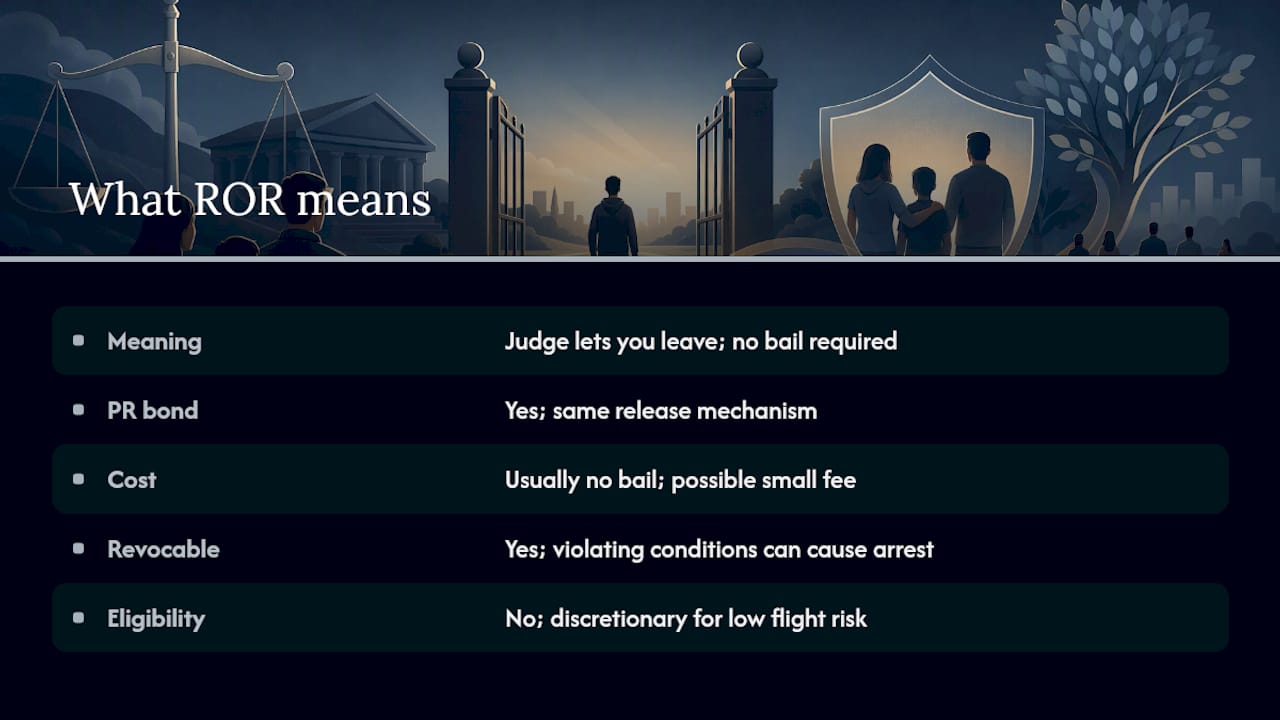
Does everyone qualify for own recognizance release? No. It's discretionary, and courts generally reserve it for defendants who show low flight risk and no threat to public safety.
Sources
- Release And Detention Pending Judicial Proceedings (18 U.S.C. 3141 Et Seq.) - U.S. Department of Justice
- Law
- What Does a PR Bond Mean and How Does It Work? - LegalClarity
Recommended
- CAPRAI, CASEY GLENN charged with DOC CONTRACT · Registry Recognizer
- SHAWANO COUNTY SEEKS TO ENFORCE COURT ORDER AFTER VIOLATION INCIDENT · Registry Recognizer
- Dangelo Sanchez charged with PC 3455(A) - VIOLATION OF POST RELEASE SUPERVISION · Registry Recognizer
- BALFOUR, GLENN THOMAS charged with Arrest: 50B-4 - DV PROTECTIVE ORDER VIOL (M); Arrest Date 07/02/2026; Bond - No Bond; Set By MILLER; · Registry Recognizer